Sydney service businesses miss an average of 30-40 percent of inbound calls during on-site work hours. 72 percent of mobile callers do not leave voicemail and will call the next operator within minutes. Auto-SMS recovery within 60 seconds of a missed call retains most of these customers without any manual intervention. The economics are simple: recovering one missed $400 job per week pays for most recovery systems within days.
- 30-40% of service business calls go unanswered during working hours
- 72% of callers do not leave voicemail and do not call back
- First-responder advantage: 85% of service customers book the first operator who calls back
- Auto-SMS within 60 seconds of missed call retains most customers
- Call tracking reveals exactly how many leads you are currently losing
- After-hours calls are a separate problem requiring a different solution
You are under a sink. Phone rings three times. You cannot get to it. The caller hangs up. You finish the job, see the missed call, and ring back 40 minutes later to no answer.
That customer is already on the phone with someone else. Or they have already booked. You will never know which.
This happens to every Sydney service business that does on-site work. The question is whether you have a system in place to recover the situation before the customer moves on.
Why missed calls happen and why they cost more than they should
Missed calls are not a sign of a bad business. They are a natural outcome of doing on-site work. You cannot answer your phone while you are up a ladder, under a car, or running a machine.
The problem is not the missed call. The problem is the absence of any response in the critical window between the missed call and the customer's decision to try someone else.
The cost of one missed call per week
If your average job is $400 and you are missing one genuine enquiry per week that you cannot recover, that is $20,800 per year walking out the door. Most operators are missing more than one per week.
The four patterns of missed calls in Sydney service businesses
Pattern 1: On-site call while physically occupied
The most common. You are physically unable to answer. The fix is an auto-response that reaches out to the caller immediately.
Pattern 2: Call during a customer conversation
You are talking to one customer and another call comes in. You cannot answer without appearing rude to the person in front of you. An auto-response handles the incoming caller until you can follow up.
Pattern 3: After-hours calls
A customer searches for a plumber at 9pm. They call the number on the website. No answer, no voicemail, no callback. The next morning, they have already booked someone else. An after-hours auto-response that acknowledges the call and confirms next-morning contact retains these customers at a high rate.
Pattern 4: High-volume busy periods
Ironically, your busiest periods are when you miss the most calls. Summer for air conditioning. Storm season for emergency drainage. The times when new customers are most actively searching are the times when you are too busy to answer.
The real cost of a missed call for Sydney service businesses
A missed call is not just a lost enquiry. It has a compounding cost that most businesses underestimate.
These numbers assume zero recovery. In practice, some callers do ring back, or you return some calls quickly enough to catch them. But the gap between what could be recovered and what actually is recovered is where the real loss sits.
| Trade type | Typical weekly missed calls | Average job value | Weekly revenue at risk |
|---|---|---|---|
| Plumber | 4-8 calls | $420 | $1,680-$3,360 |
| Electrician | 3-6 calls | $480 | $1,440-$2,880 |
| Domestic cleaner | 6-12 calls | $220 | $1,320-$2,640 |
| Landscaper | 3-7 calls | $680 | $2,040-$4,760 |
| Pest control | 2-5 calls | $320 | $640-$1,600 |
What to do about missed calls
The solution is a two-part system: an immediate acknowledgement to the caller and an immediate alert to you.
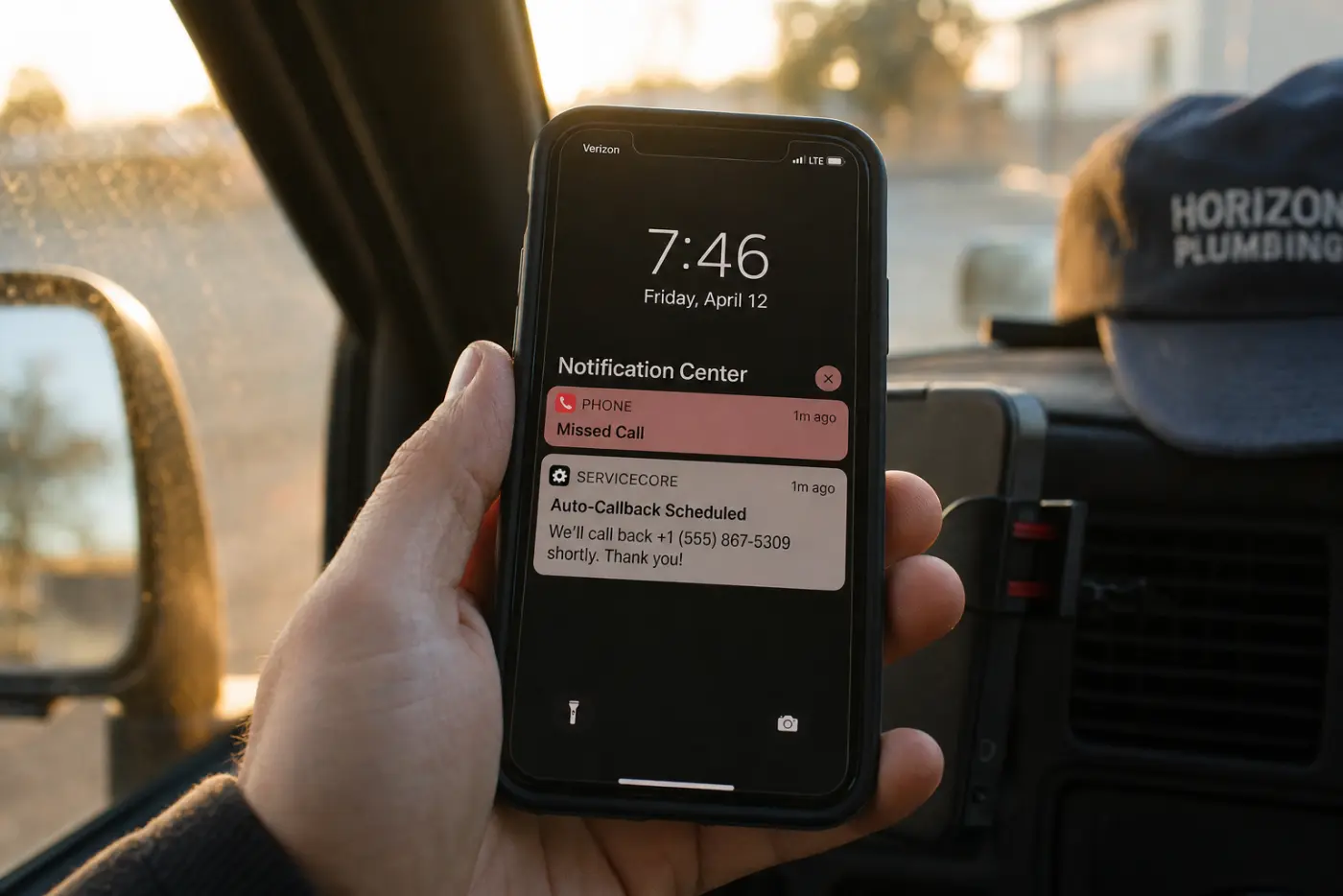
Auto-SMS to the caller within 60 seconds
The message does not need to be long. 'Hi, we missed your call. We will ring you back shortly. If it is urgent, reply to this message.' That is enough to hold most customers in the pipeline.
Alert to your phone or smart watch
You receive a notification with the caller's number. When you put down your tools, you see it immediately. You do not have to remember to check missed calls.
Callback within the hour
Most customers who received an acknowledgement SMS will wait for a callback within an hour. Beyond that, your recovery rate drops significantly.
What good recovery looks like
A business running a missed call recovery system properly will recover 60-70 percent of otherwise-lost enquiries. Without any system, recovery rate is typically under 20 percent (only the most motivated callers ring back on their own).
Tracking your missed call rate
Before fixing the problem, it helps to know how large it is. Call tracking software can show you exactly how many calls you receive per week, how many go unanswered, and what your average answer time is.
Most Sydney service businesses are surprised by how high their missed call rate is. Seeing the number makes the case for investing in recovery much more concrete.
What this article is not claiming
There are no made-up retention percentages or enquiry counts in this piece. The framework above is what we have seen play out for service businesses on our own program and what other operators in the space report, but the numbers that matter for your business are the ones for your suburb and your service category, which we can only work out together.
If you want a sample of what an actual enquiry looks like when it lands, ring us and we will send you a sanitised SMS example from a similar trade. That is more useful than any blog statistic.